The Three Options Flowchart Slide Template: A Tool for Strategic Visualization
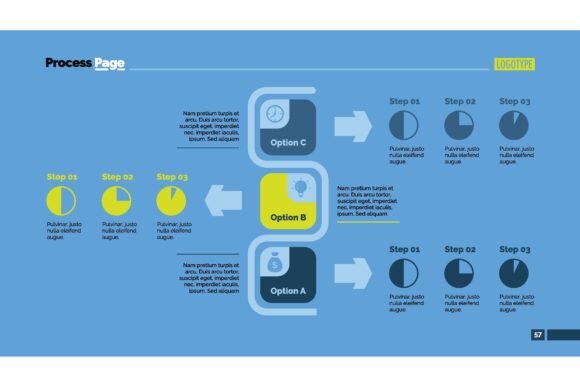
In the world of professional communication, clarity is paramount. Whether you are presenting a new business strategy to stakeholders, outlining a project plan to your team, or explaining a complex process in an educational setting, the ability to distill multifaceted information into a clear, digestible visual is a critical skill. The Three Options Flowchart Slide Template serves as a foundational asset for this exact purpose. It is not merely a slide with boxes and arrows; it is a structured framework designed to map out scenarios where a key decision or action leads to three distinct, potential outcomes or pathways.
Where the Template Fits in Your Process
This template functions as a central node in a larger workflow of planning and communication. Its use typically occurs after initial brainstorming and analysis, but before final execution or detailed implementation. Imagine you have identified a core challenge, opportunity, or decision point. You have gathered the data and considered the possibilities. The Three Options Flowchart Slide Template is the tool you employ to synthesize that analysis into a visual story. It acts as the bridge between raw information and audience understanding, fitting seamlessly into stages like strategic review meetings, client proposal development, training module creation, or personal project planning.
Its role is interactive. It often draws from inputs like market research data, team feedback, financial projections, or risk assessments. The completed flowchart then becomes an input for subsequent actions: guiding discussion, informing a final choice, or serving as a reference point in a larger project document. It interacts with other resources by providing a visual summary that complements detailed reports, financial spreadsheets, or verbal explanations, enhancing overall comprehension and alignment.
Practical Applications Across Fields
The adaptability of the Three Options Flowchart Slide Template is one of its strongest features. Its structure is simple enough to be universally understood, yet robust enough to handle specialized content.
- Business Strategy: Present three potential market entry strategies (direct launch, partnership, acquisition) with their respective pros, cons, and resource implications.
- Project Management: Outline three contingency plans for a critical project phase, showing the trigger event and the different response paths.
- Product Development: Visualize three user feedback-driven iteration paths for a feature, leading to different design and development priorities.
- Educational Content: Explain a historical decision with three possible consequences, or a scientific process with three divergent results based on initial conditions.
- Personal Decision-Making: Map out three career advancement options, each with associated steps, investments, and potential outcomes, for clear personal evaluation.
In each case, the template forces a distillation of complexity. It requires you to define the central decision point clearly and then thoughtfully limit the outcomes to three coherent paths. This limitation is a feature, not a bug; it encourages prioritization and focus, preventing visual clutter and cognitive overload for your audience.
Integrating the Template into Your Workflow
Successful integration of this tool relies on preparation and a clear understanding of its purpose. Begin by defining the singular "Start Point" or "Decision Node" for your flowchart. This should be a specific action, question, or event. Ambiguity at this stage will weaken the entire visualization.
Next, rigorously develop the three options. They should be genuinely distinct, not minor variations of the same path. Consider using a separate brainstorming session or a SWOT analysis for each option to flesh out the details that will populate the subsequent steps in each flowchart branch. The template's effectiveness hinges on the quality of the content you feed into it.
Compatibility and usability are high. The template is typically used in presentation software like PowerPoint, Google Slides, or Canva, but its core structure can be sketched on a whiteboard, drawn in a notebook, or replicated in collaborative online diagram tools. The key is consistency in design—using uniform shapes, connectors, and perhaps color coding for each option path—to enhance readability. This consistency acts as a form of quality control, ensuring the visual communicates professionally.
Execution Tips for Maximum Impact
Beyond filling in the boxes, consider these practical tips to leverage the template fully.
- Label with Action-Oriented Language: Use verbs. Instead of "Option A," label a path "Launch Minimal Viable Product." Instead of a generic step, use "Conduct Pilot Test with 100 Users." This makes the flowchart dynamic and process-oriented.
- Incorporate Key Metrics: Where applicable, add small, crucial data points within the flowchart steps. For a business option, note "Est. Cost: $20K" or "Timeframe: 3 months." This integrates quantitative analysis directly into the visual.
- Design for Discussion, Not Just Display: Build the slide to be interactive. Present the central decision and the three paths, then use the subsequent slides to drill down into each option individually. The template slide becomes a agenda-setting visual for a deeper conversation.
- Maintain a Library for Long-Term Use: Once you have developed a well-structured flowchart for one project, save it as a master template. Adapt it for future use. This builds organizational efficiency and ensures a consistent visual language across your presentations over time.
The Outcome: Enhanced Understanding and Alignment
The ultimate value of the Three Options Flowchart Slide Template lies in the outcomes it facilitates. It transforms abstract discussion into a shared visual reference, minimizing misunderstandings. In a team setting, it helps align members around the possible directions, making the pros and cons of each path tangible. For an individual, it externalizes a complex internal decision process, allowing for clearer self-assessment.
It also promotes efficiency. By forcing a structured breakdown of options, it often reveals redundancies or unrealistic paths early in the planning process. This can save significant time and resources later. Furthermore, as a communication asset, it increases the persuasiveness and credibility of your proposal. A clear, professional flowchart demonstrates thorough preparation and systematic thinking, building trust with your audience—whether they are investors, students, or colleagues.
In essence, this template is more than a slide; it is a methodology encapsulated in a visual format. It guides you to define, differentiate, and delineate. By integrating it smoothly into your planning and presentation routines—from the initial preparation of robust content to the consistent application of design principles—you elevate not only the quality of your visuals but the clarity and impact of your strategic communication. It becomes an essential partner in making the complex gracefully simple.