A Practical Guide to Comic Icons for Modern Creators
In digital design, the visual shorthand of icons is indispensable. A well-chosen set can elevate user interfaces, clarify complex information, and establish brand personality. Comic Icons presents a specific aesthetic approach: a collection of high-quality icons characterized by a playful, approachable style built on minimalist foundations. This is not merely a bundle of graphics; it is a comprehensive resource designed for integration into professional workflows across a remarkably wide range of media.
Understanding the Comic Icons Design Philosophy
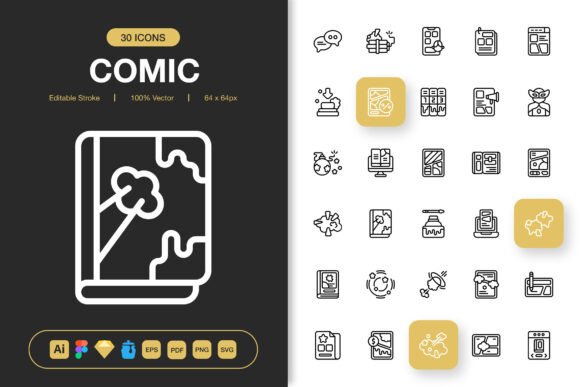
The term "comic" here refers less to a genre and more to a design sensibility. These icons typically employ clear outlines, simplified forms, and a sense of narrative charm. The strength of Comic Icons lies in its marriage of this distinct character with minimalist principles. Each icon is reduced to its essential visual elements, ensuring it remains legible and effective even at small sizes. This combination creates assets that are friendly without being childish, professional without being sterile, making them suitable for projects targeting a broad adult audience.
The minimalist core is crucial for practical application. Overly detailed icons can become visual noise in a mobile app interface or lose clarity in a printed flyer. By prioritizing clean lines and unambiguous shapes, Comic Icons maintains its utility. The aesthetic is consistent across the set, which is vital for establishing visual cohesion. Whether used on a website, in an infographic, or on social media, they work as a unified system.
Core Features and Their Practical Implications
The provided feature list translates directly into real-world usability. The inclusion of editable stroke means each icon's line weight can be adjusted. This is a significant advantage for adapting icons to different contexts; a thicker stroke might be used for a bold poster, while a thinner one suits a sleek app screen.
The file format assortment is notably professional. Receiving the source file in Adobe Illustrator alongside Figma, Sketch, and EPS versions ensures compatibility with nearly any standard design environment. For developers or quick implementations, the SVG and PNG files are provided in a logical range of sizes (32px to 512px), covering everything from favicons to large display graphics. The IconJar file facilitates organized management within design software. This multi-format delivery removes a common barrier: asset conversion, which often consumes considerable time and can degrade quality.
Evaluating Quality and Flexibility
High quality in icon sets is defined by several factors: visual consistency, technical precision, and scalability. A set like Comic Icons must demonstrate uniform stroke style, balanced proportions, and a cohesive color palette if one is included. The technical precision is evident in the vector formats (AI, EPS, SVG); these allow for infinite scaling without pixelation, which is essential for print applications like banners or books where resolution demands are high.
Flexibility, however, extends beyond scaling. The "100 Customizable" descriptor suggests the icons are built to be modified. This could mean layers are logically grouped in the source files, allowing for easy color changes, component rearrangements, or stylistic tweaks. For a brand needing to align icons with its specific color scheme, or a creator wanting to merge two icon concepts, this customizable structure offers long-term value beyond initial use.
Digital Interface and Web Design
For website and mobile app projects, icons serve as functional navigation elements and visual cues. The minimalist design of Comic Icons ensures they do not compete with other content for attention. Their friendly style can make an interface feel more welcoming, which can be particularly effective for educational platforms, community apps, or service-based businesses aiming to reduce user apprehension.
Print and Marketing Materials
In print media—flyers, posters, banners—icons must retain clarity at various viewing distances and sizes. The vector source files guarantee this. The comic aesthetic can make informational graphics, like process diagrams or service lists in a brochure, more engaging. Their style can help a flyer stand out in a stack of more conventionally designed competitors.
Content Creation and Publishing
Bloggers, educators, and publishers often need to create consistent visual materials quickly. The drag-and-drop convenience of ready PNGs, coupled with the organization provided by the IconJar file, speeds up this process. Whether illustrating a blog post about teamwork, creating a slide deck for a presentation, or designing chapter headers for an ebook, having a reliable, consistent set on hand improves production efficiency.
Audience Fit and Professional Considerations
This resource aligns well with the needs of professionals, entrepreneurs, and creators who require a versatile visual asset library but lack the time or budget for custom illustration. Freelancers can leverage Comic Icons across multiple client projects, ensuring a professional look while managing their time effectively. Small business owners developing their own marketing materials can achieve a cohesive visual identity without deep design expertise.
A potential limitation to consider is the specific stylistic tone. While versatile, the comic style may not align with projects requiring a formal, corporate, or ultra-tech aesthetic. The value is highest for projects where approachability, clarity, and a touch of personality are desired outcomes. It is also important to verify the licensing terms, even with purchased sets, for commercial usage in large-scale products.
Final Observations on Long-Term Utility
The true measure of a design resource is its longevity. Comic Icons, through its minimalist foundation and comprehensive file support, is built for reuse. The editable and customizable nature means it can adapt to evolving brand guidelines or new project requirements. Unlike static PNG bundles that become obsolete with changing design trends or resolution standards, the vector source files allow the set to be perpetually updated and refined.
For anyone regularly engaged in design-driven work—from app development to content marketing—investing in a robust, high-quality icon set is a pragmatic decision. Comic Icons represents a focused option within that category, offering a distinct style coupled with the technical robustness necessary for serious projects. Its suitability hinges on whether its playful yet minimalist character serves the intended message and audience. When it does, it provides a reliable, scalable, and efficient visual foundation.