Navigating Icon Selection with Seafood Icons
In today’s digital landscape, visual communication is paramount. For anyone creating a website, app, or marketing material, the quality and coherence of your visual elements can determine success or obscurity. Many creators, from hobbyists to seasoned professionals, understand the need for strong iconography but often stumble in the selection and implementation process. This is where a focused, high-quality set like Seafood Icons becomes a powerful asset, not just a collection of graphics.
The Common Pitfall of Scattered Icon Sources
A frequent mistake made by beginners and even professionals is piecing together icons from various free or disparate sources. You might find a perfect lobster icon from one site, a decent fishing boat from another, and a shrimp icon from a third. While this seems cost-effective, it introduces a host of problems. The stylistic consistency will be lacking—line weights, color palettes, and design philosophies will clash. This results in a visual interface that feels amateurish and disjointed, undermining user trust and brand perception. For a project centered around seafood—a restaurant website, a marine conservation app, a cookbook—this incoherence directly weakens your core message.
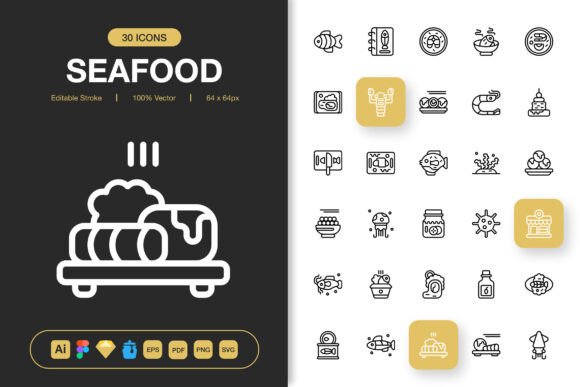
Choosing a dedicated set like Seafood Icons solves this at the root. Every icon is crafted within the same minimalist design framework, ensuring that whether it’s a salmon fillet or a fishing net, they speak the same visual language. This cohesion is something users and clients perceive instantly, elevating the perceived quality of your entire project.
Understanding True Flexibility and Editability
Many icon purchases are made on the surface promise of “editable” or “customizable.” A common oversight is not verifying what that actually means. If you receive only static PNG files at fixed sizes, your ability to adapt them is severely limited. Changing a color to match a brand update, adjusting the stroke weight to fit a new layout, or scaling without quality loss becomes impossible, forcing you back to the search for a new icon or into tedious manual editing.
The feature list of Seafood Icons highlights a crucial detail: Editable Stroke and the inclusion of source files like Adobe Illustrator, Figma, and SVG. This is the practical definition of customizable. It means the icon is not a frozen image but a malleable design object. You can open the vector file and change the stroke from thin to thick, recolor every element without pixelation, or even modify the shape slightly to better suit your need. This level of control is what transforms an icon set from a static asset into a long-term design partner that adapts as your projects evolve.
Why File Format Diversity Matters
Another underestimated aspect is the range of file formats provided. Receiving only a PNG or a single SVG might work for one specific use case but fail for another. Professionals working across different platforms—web (SVG), print (EPS, PDF), and screen-based apps (PNG at multiple resolutions)—need the right file for the right job. Using a low-resolution PNG in a printed banner leads to blurry, unacceptable results. Conversely, using a complex vector file unnecessarily in a mobile app might impact performance.
Seafood Icons addresses this by supplying the icon in multiple practical formats tailored for different outputs: the scalable vector formats (AI, EPS, SVG) for design and editing, and ready-to-use PNGs at a spectrum of sizes (from 32px for mobile interfaces to 512px for high-density displays). This eliminates the risk of format mismatch, saving you hours of conversion work and ensuring pixel-perfect presentation across media.
The Efficiency of a Complete, Drag-and-Drop Library
Time is a critical resource for entrepreneurs and freelancers. Searching for individual icons, downloading them, converting formats, and organizing them into a project library is a hidden drain on productivity. The Easy Drag and Drop capability, supported by the included IconJar, Sketch, and Figma files, is not a minor convenience; it’s a workflow revolution. These files allow you to import the entire set as a cohesive library into your preferred design tool. Suddenly, instead of hunting, you’re browsing and dragging. This streamlined process keeps you focused on the larger creative task, significantly boosting efficiency and reducing project turnaround time.
What to Check Before You Commit
Before finalizing any icon set purchase, a pragmatic checklist can prevent regret. First, scrutinize the license. Can you use these icons for commercial projects, client work, and across the mediums you need (web, print, apps)? Seafood Icons, suited for “any project,” typically implies broad commercial use, but always confirm. Second, examine the scope of the set. Does the collection cover the specific seafood concepts you require? A good set should offer comprehensive coverage for its theme. Third, verify the technical delivery. Are the source files truly included as advertised? The presence of Illustrator and Figma files is a strong indicator of professional-grade editability.
Finally, consider the design philosophy. Minimalist icon design, as offered here, is not just an aesthetic trend. It’s a functional choice. Minimalist icons are clearer, load faster on websites, and remain legible at small sizes. They reduce visual clutter, making your information easier to digest in infographics, flyers, and apps. Embracing this style with a dedicated set like Seafood Icons can genuinely change your next projects by instilling a principle of clarity and purpose from the ground up.
Moving Beyond One-Time Use
The ultimate value of a well-chosen icon set lies in its recurring utility. Viewing Seafood Icons not as a purchase for one project, but as a permanent addition to your design toolkit, shifts the perspective. Because the icons are high-quality, customizable, and multi-format, they can be adapted and reused across future websites, updated marketing campaigns, new mobile app features, or educational materials. This long-term applicability makes it a cost-effective decision, amortizing the initial investment over many projects and years of creative work.
By avoiding the common pitfalls of inconsistent sourcing, misunderstanding customization, and neglecting file format needs, you position your projects for visual success. Integrating a cohesive, professional set like Seafood Icons provides not just graphics, but a foundation for clear, attractive, and effective communication across all the platforms where your audience lives.